

The JOG Framework, developed by NIC Kerala, is a secure application deployment and management framework built on Jenkins, OpenSearch and Gitea. Designed to support departmental ownership of data and infrastructure, the framework eliminates the need for SSH or remote access to production servers while enabling automated deployments, centralized monitoring and real-time operational visibility. By integrating source control, deployment automation and log analytics into a unified workflow, JOG enhances transparency, security and efficiency in managing e-Governance applications.
The National Informatics Centre (NIC) develops and maintains a wide range of e-Governance applications for government departments across the country. A fundamental principle guiding these initiatives is that ownership, control and stewardship of data must remain entirely with the concerned department.
Traditionally, application deployment and maintenance often required development teams to access production environments through mechanisms such as SSH or FTP. While operationally convenient, such practices can raise concerns regarding data integrity, accountability and transparency, particularly in government systems handling sensitive information.
To address these challenges, NIC Kerala has developed the JOG Framework—a secure deployment and application management framework that enables end-to-end software delivery without granting developers direct access to production servers. Built using open-source technologies including Jenkins, OpenSearch and Gitea, the framework supports automated deployment, centralized observability and controlled operational workflows while preserving departmental control over infrastructure and data.
Framework Overview
JOG is designed around a simple principle: application delivery should be possible without remote server access.
The framework integrates source code management, deployment automation and log analytics into a unified workflow. Developers continue using their existing Git-based development practices, while all deployment activities are executed through automated pipelines triggered by repository events.
Whenever code is pushed to a designated branch in Gitea, a secure webhook initiates a deployment workflow in Jenkins. The framework automatically retrieves source code, fetches required dependencies and resources, executes build processes and deploys the application to production environments. Each stage is logged and audited, ensuring complete traceability of deployment activities.
Simultaneously, application logs, server logs and deployment logs are streamed to OpenSearch, providing development and operational teams with comprehensive visibility into application behaviour and infrastructure performance. As a result, troubleshooting and operational support can be performed through centralized dashboards rather than through direct server access.
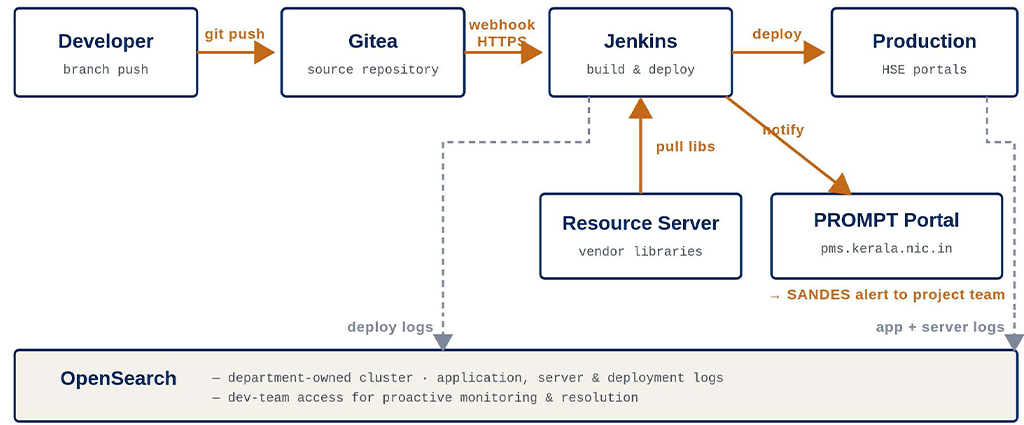
 Fig: 12.1 : JOG Architecture
Key Features
The JOG Framework offers several capabilities that strengthen security, governance and operational efficiency:
- SSH-less and access-free deployment to production environments
- Support for existing Git-based branching and development workflows
- Webhook-triggered deployment pipelines over secure HTTPS channels
- Configurable automatic and approval-based deployment mechanisms
- Real-time deployment notifications through SANDES integration
- Secure source retrieval using IP-whitelisted HTTPS connections
- Centralized collection of application, server and deployment logs
- Direct dashboard-based monitoring for development teams
- Complete auditability of deployment activities
- Fully open-source architecture with no licensing or subscription costs
Deployment Workflow
The deployment lifecycle begins when developers push code to designated branches in Gitea. A webhook event securely triggers the corresponding Jenkins pipeline.
The pipeline executes a sequence of atomic deployment stages, including:
- Source code checkout
- Retrieval of shared resources and dependencies
- Application build and packaging
- Validation and deployment
- Deployment status reporting
Depending on departmental requirements, deployments may be fully automated or routed through approval workflows before release to production environments.
Upon successful completion, Jenkins communicates deployment outcomes to the PROMPT Portal, which subsequently delivers notifications to project stakeholders through SANDES. This ensures that all production changes are immediately communicated to the project team.
Every deployment activity is recorded in OpenSearch, creating a complete audit trail and enabling detailed operational analysis.
Centralized Monitoring and Observability
A distinguishing feature of the JOG Framework is its integrated observability architecture.
Beyond deployment logging, the framework continuously collects application logs and server logs and streams them to a department-owned OpenSearch cluster. Development teams are provided controlled access to monitoring dashboards, allowing them to observe application health, identify anomalies and analyse performance trends in real time.
This approach shifts operational support from reactive troubleshooting to proactive monitoring. Issues such as application errors, service disruptions and performance bottlenecks can be identified and addressed through dashboard analytics, significantly reducing the need for server-level intervention.
The result is a secure operational model that maintains separation between application management and infrastructure access while preserving full visibility into system behaviour.
Benefits and Impact
Implementation of the JOG Framework has delivered several tangible benefits:
- Elimination of SSH and direct server access to production environments
- Enhanced protection of departmental data and infrastructure
- Improved transparency and accountability through fully auditable deployment workflows
- Reduction in deployment-related human errors through automation
- Faster issue identification and resolution through centralized monitoring
- Improved collaboration through automated notifications and shared operational visibility
- Lower operational costs through the use of open-source technologies
- Complete deployment within existing on-premise government infrastructure
By combining automation, observability and governance, the framework establishes a secure and scalable model for managing e-Governance applications.
Technical Architecture
The framework is deployed entirely within departmental data centres using existing government infrastructure. All components are open-source and operate on-premise, eliminating dependency on external cloud services.
The architecture comprises the following major components:
| Particulars | Technology/Tools Used |
|---|---|
| Gitea | Self-hosted source code management platform |
| Jenkins | Automated build and deployment orchestration |
| OpenSearch & OpenSearch Dashboards | Centralized log aggregation, analytics and monitoring |
| PROMPT Portal | Project Resource Organisation and Management Planning platform for project administration and notifications |
| Resource Server | Repository for versioned libraries, dependencies and build assets |
| Fluent Bit | Log collection and forwarding |
| NGINX on Ubuntu LTS | Secure web serving and reverse proxy services |
Communication between components is secured using HTTPS, IP whitelisting and locally trusted certificate authorities.
Way Forward
NIC Kerala is progressively extending the JOG Framework across additional departmental applications and service platforms. Future enhancements will focus on advanced alerting mechanisms, anomaly detection capabilities, expanded approval workflows and deeper integration between deployment automation and operational analytics.
These developments will further strengthen secure application delivery practices while reducing operational dependencies on direct server access. As government systems continue to scale, frameworks such as JOG provide a robust foundation for transparent, secure and efficient management of digital public services.
- Edited by:C. J. ANTONY
Author / Contributor

Bindu S. Kumar Dy. Director General bindu.sk[at]nic[dot]gov[dot]in

Vipin Bose Scientist-C bose.vipin[at]nic[dot]gov[dot]in
- Tag:
- Internet
- Technology
- eGov
- Tech
Bindu S. Kumar
Dy. Director General
NIC Keralam State Centre
CDAC Building Vellayambalam
Thiruvananthapuram Keralam - 695033
Share