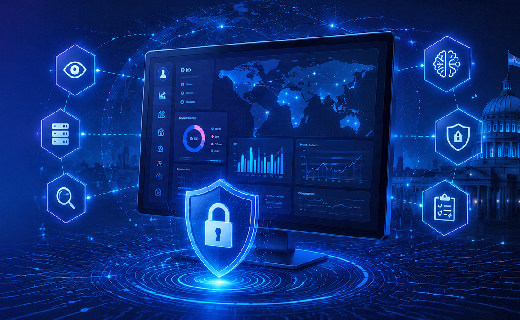
SIEM is evolving from a log management tool into an intelligent security backbone for modern digital systems. By combining centralized visibility, analytics, and AIdriven capabilities, it enables Organisations to move from reactive defense to proactive security—making it indispensable for resilient, compliant, and future-ready cybersecurity operations, especially in complex government environments.
In today’s rapidly evolving cyber-threat landscape, government departments rely heavily on secure and uninterrupted digital systems to deliver public services, citizencentric applications, and critical infrastructure operations. The increasing scale and sophistication of cyber threats necessitate a centralized and proactive approach to security monitoring and incident response.
Security Information and Event Management (SIEM) plays a pivotal role in addressing this need by enabling Organisations to collect, correlate, and Analyse log data from servers, endpoints, applications, and network devices across the IT ecosystem. By transforming raw event data into actionable security insights, SIEM provides a unified view of system activity and helps identify anomalous behaviour in real time.
Through event correlation and log standardization, SIEM solutions detect potential threats, generate prioritized alerts, and support timely incident response. They also facilitate forensic investigations, trend analysis, and regulatory compliance with national cybersecurity frameworks such as CERT-In, NIC, and AP SOC guidelines.
For government Organisations responsible for sensitive data and critical public services, SIEM serves as a foundational capability for strengthening security posture, improving operational visibility, and ensuring resilience against emerging cyber risks.
How SIEM Technology Works
SIEM solutions operate through a structured and continuous process of collecting, processing, and analyzing security data from across an Organisation’s IT environment. This includes system logs, user activities, network traffic, endpoints, applications, and servers, enabling comprehensive visibility into security events.
The working of a SIEM system can be understood through the following key stages:
- Data Collection: SIEM platforms gather log and event data from multiple sources, including firewalls, intrusion detection systems, servers, databases, and cloud environments, ensuring broad coverage across the infrastructure.
- Data Normalization and Aggregation: Collected data is standardized into a consistent format, allowing events from different systems to be compared and Analysed collectively.
- Event Correlation: SIEM applies predefined rules, statistical models, and threat intelligence to correlate related events, helping identify patterns that may indicate malicious activity.
- Threat Detection and Alerting: Based on correlation and analysis, the system detects anomalies and generates prioritized alerts, enabling security teams to focus on high-risk incidents.
- Response and Investigation: SIEM supports incident response by providing contextual information, enabling faster investigation, containment, and remediation. Advanced platforms may also trigger automated responses.
This structured workflow allows SIEM to transform large volumes of raw data into actionable intelligence, enabling Organisations to detect threats early, respond efficiently, and maintain continuous security monitoring.
Core Components of SIEM
A SIEM system is built on a set of integrated components that work together to provide end-to-end visibility, detection, and response capabilities across the IT environment. These components enable the system to process large volumes of data, identify threats, and support security operations effectively.
- Log Data Management: Forms the foundation of SIEM by collecting, storing, and managing log data from diverse sources. It ensures data integrity, normalization, and availability for analysis, auditing, and compliance.
- Security Event Management (SEM): Focuses on real-time monitoring and analysis of security events. By correlating live data from multiple sources, SEM enables rapid detection of suspicious activities and immediate alert generation.
- Security Information Management (SIM): Handles the storage and analysis of historical data, supporting incident investigation, trend analysis, and compliance reporting through dashboards and detailed logs.
- Event Correlation and Analytics: Combines data from various systems using rules, statistical models, and threat intelligence to identify patterns and uncover complex or hidden threats.
- User and Entity Behavior Analytics (UEBA): Uses machine learning to establish baseline behaviour for users and systems, helping detect anomalies such as insider threats or compromised accounts.
- Threat Intelligence Integration: Enhances detection capabilities by incorporating external threat feeds, providing contextual information to identify known attack patterns and emerging risks.
- Alerting and Incident Response: Generates prioritized alerts based on detected threats and supports structured response workflows, including investigation, containment, and remediation. Advanced systems may enable automated responses.
- Reporting, Audit, and Compliance: Provides dashboards, reports, and audit trails required for regulatory compliance, while offering insights into security posture and operational trends.
AI-Driven Evolution of SIEM
As cyber threats grow in scale and complexity, traditional SIEM systems are evolving into intelligent, adaptive platforms powered by artificial intelligence (AI) and machine learning (ML). This transformation is enabling Organisations to move beyond reactive monitoring toward predictive and automated security operations.
AI-driven SIEM solutions enhance threat detection by analyzing large volumes of realtime and historical data to identify patterns, anomalies, and emerging attack vectors with greater accuracy. By continuously learning from system behaviour, these platforms can detect subtle deviations that may indicate insider threats, compromised accounts, or previously unknown attacks.
Automation is another key advancement shaping modern SIEM capabilities. Integrated with orchestration frameworks, SIEM systems can trigger predefined responses, reducing manual intervention and enabling faster containment of security incidents. This not only improves response time but also minimizes the operational burden on security teams.
In addition, AI significantly improves alert prioritization and noise reduction. By providing contextual analysis and filtering false positives, it allows security analysts to focus on high-impact threats, thereby enhancing decision-making and operational efficiency.
The evolution of SIEM is also closely aligned with emerging cybersecurity frameworks and architectures. Integration with cloud environments, Zero Trust models, and Extended Detection and Response (XDR) platforms is expanding the scope of visibility across distributed and hybrid infrastructures. At the same time, the growing emphasis on data privacy and regulatory compliance is reinforcing the role of SIEM in governance and audit readiness.
Looking ahead, SIEM is expected to become more scalable, automated, and context-aware— serving not only as a monitoring tool but as a central intelligence layer within the cybersecurity ecosystem. This evolution will play a critical role in enabling Organisations, particularly in the public sector, to strengthen resilience, ensure continuity of services, and stay ahead of increasingly sophisticated cyber threats.
Best Practices for SIEM Implementation
Effective SIEM deployment requires a strategic approach that aligns technology, processes, and people with the Organisation’s security objectives. A well-implemented SIEM system not only enhances threat detection but also ensures long-term operational efficiency and scalability.
- Define Clear Objectives: Establish specific goals for SIEM implementation, such as threat detection, compliance, or incident response. Clearly defined use cases help prioritize efforts and guide system configuration as security maturity evolves.
- Ensure Comprehensive Data Integration: Integrate logs from critical sources, including firewalls, endpoints, identity systems, applications, and cloud environments. Comprehensive data coverage is essential for accurate threat detection and visibility.
- Prioritize Critical Log Sources: Begin with high-value systems such as Active Directory, network devices, and cloud platforms to ensure early visibility into sensitive and high-risk areas.
- Enable Continuous Monitoring and Optimization: Regularly review and update correlation rules, dashboards, and alerts to adapt to evolving threat landscapes. Continuous tuning helps maintain accuracy and relevance.
- Leverage Automation and Threat Intelligence: Incorporate automation and orchestration capabilities to streamline incident response. Regularly update threat intelligence feeds to enhance detection of emerging risks.
- Strengthen Team Capability and Training: Equip security operations teams with the necessary skills to interpret alerts, investigate incidents, and Optimise SIEM performance. Ongoing training in areas such as cloud security and data analytics is essential.
- Foster Cross-Team Collaboration: Ensure coordination between IT, security, and compliance teams to improve communication among employees and management, align priorities, and strengthen overall security posture.
- Support Compliance and Audit Readiness: Configure SIEM to meet regulatory requirements by enabling proper log retention, reporting, and audit trails, ensuring readiness for inspections and assessments.
Conclusion
In today’s dynamic threat landscape, SIEM has become a core component of cybersecurity by delivering unified visibility, real-time detection, and actionable insights across complex environments. The integration of AI is further transforming SIEM into a more intelligent and adaptive platform, enabling faster threat identification, improved alert prioritization, and more efficient incident response.
As cyber threats continue to evolve, SIEM will play a critical role in strengthening Organisational resilience, supporting compliance, and ensuring business continuity. Its continued advancement toward automation and predictive capabilities will enable security teams to respond more effectively while aligning security operations with broader Organisational objectives.
- Edited by:MOHAN DAS VISWAM
Author / Contributor

S. V. Ch. Subba Rao Dy. Director General & SIO srao[at]nic[dot]in

Erina Kiran Kumar Technical Director erina.kiran[at]nic[dot]in
- Tag:
- Internet
- Technology
- eGov
- Tech
S. V. Ch. Subba Rao
Dy. Director General & SIO
NIC Andhra Pradesh State Centre
3rd Floor, R&B Building, M.G. Road
Vijayawada, Andhra Pradesh – 520010
Share