
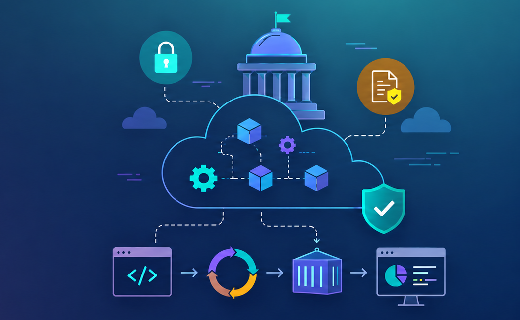
In recent years, the shift toward microservices and cloud-native architectures has quietly transformed how government applications are designed and delivered. Systems that once evolved slowly now demand rapid iteration, continuous integration, and uncompromising security. Yet, within government infrastructure, this transformation must unfold in a controlled, sovereign, and policy-compliant environment.
In recent years, the shift toward microservices and cloud-native architectures has quietly transformed how government applications are designed and delivered. Systems that once evolved slowly now demand rapid iteration, continuous integration, and uncompromising security. Yet, within government infrastructure, this transformation must unfold in a controlled, sovereign, and policy-compliant environment.
It is within this context that the DevOps Lab at National Informatics Centre (NIC) IDC Trivandrum emerges—not merely as a technical setup, but as a working model of modern application lifecycle management within government boundaries.
Established by NIC's Centre of Excellence on Microservices (CEM), Kochi, the lab is designed as a hands-on learning and demonstration platform, simulating a real-world enterprise DevOps ecosystem using dedicated virtual machines within IDC infrastructure. Each machine is assigned a specific role, and together they form a tightly integrated environment where development, deployment, security, and monitoring converge into a seamless pipeline.
From Code to Citizen: An Integrated DevOps Architecture
At its core, the IDC DevOps Lab embodies a structured pipeline that begins with source code and culminates in secure, monitored service delivery. Rather than functioning as isolated tools, each component participates in a continuous, interdependent workflow.
The journey begins with version-controlled code, flows through automated integration and testing, advances into containerized deployment, and finally reaches users through secure and governed access layers—all under continuous observation.
Development and Integration: Establishing the Pipeline Foundation
The lifecycle of any application in the lab begins with Git, the distributed version control system that anchors collaborative development. By maintaining centralized repositories with full traceability, Git ensures that every change is recorded, auditable, and reversible—an essential requirement in government environments.
As soon as code is committed, the pipeline is set into motion by Jenkins. This automation server orchestrates build processes, executes test cases, and prepares applications for deployment without manual intervention. The emphasis here is not merely speed, but consistency and repeatability.
Quality assurance is embedded directly into this stage through SonarQube, which performs static code analysis to detect vulnerabilities, enforce coding standards, and reduce technical debt. In systems where reliability and security are non-negotiable, this early validation becomes critical.
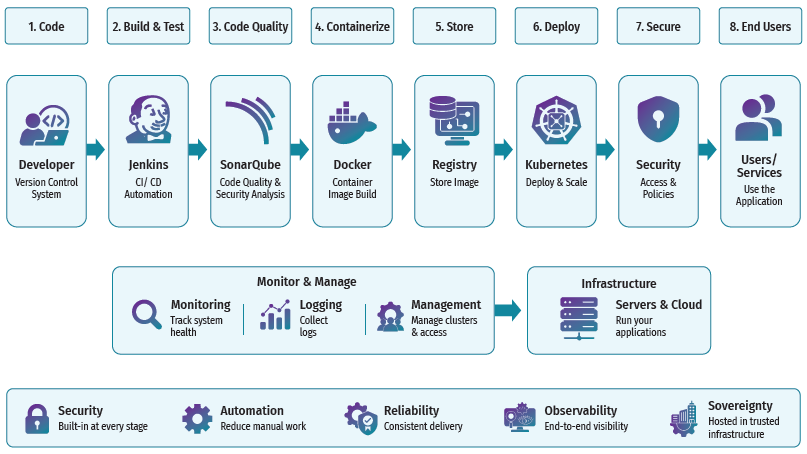 Fig: 12.1 : End-to-End DevOps Pipeline
Containerization & Deployment: Ensuring Consistency and Sovereignty
Once validated, applications are packaged into containers using Docker. This ensures that applications behave consistently across environments, eliminating discrepancies between development and production systems.
These container images are stored within a private registry hosted inside the IDC infrastructure. This design decision is particularly significant: it ensures that sensitive government application artifacts remain within NIC-controlled environments, reinforcing data sovereignty and controlled access.
Deployment is managed by Kubernetes, the orchestration backbone of the lab. It enables automated scaling, self-healing of applications, load balancing, and efficient resource utilization. By organizing workloads into logical units and isolating environments, Kubernetes supports both operational efficiency and governance.
To simplify the management of complex deployments, Helm is used as a package manager. It allows applications to be deployed, upgraded, or rolled back with minimal effort, reducing operational overhead while maintaining consistency across environments.
Security and Governance: Centralized Control in a Distributed System
In a microservices architecture, where multiple services interact across domains, identity and access management becomes a central concern. Within the IDC lab, this responsibility is handled by Keycloak, which acts as a centralized identity provider.
Supporting protocols such as OAuth2 and OpenID Connect, Keycloak enables single sign-on, role-based access control, and token-based authentication. Users authenticate once and gain access to multiple services, while administrators retain granular control over roles and permissions.
Complementing this is Apache APISIX, which functions as the API gateway—the unified entry point into the system. It routes incoming requests to appropriate backend services while enforcing policies related to authentication, rate limiting, and request validation. This ensures that all access to microservices is both secure and governed.
At the infrastructure level, Rancher provides centralized cluster management. It offers administrators a comprehensive view of clusters, workloads, and policies, simplifying the management of distributed environments and strengthening governance.
Observability: Seeing the System in Motion
A system, no matter how well designed, is only as reliable as its observability. The IDC DevOps Lab addresses this through the ELK Stack— Elasticsearch, Logstash, and Kibana.
Logs from applications, containers, and infrastructure components are aggregated and processed in real time. Kibana dashboards provide intuitive visualization, enabling administrators to monitor system health, trace errors, and respond to anomalies with speed and precision.
This continuous visibility ensures that the system remains not only functional, but predictable and accountable.
The Workflow in Practice: A Continuous, Governed Lifecycle
When viewed end-to-end, the lab represents more than a collection of tools—it is a living pipeline.
A developer commits code to the repository. Jenkins triggers automated builds and tests. SonarQube validates code quality. Docker packages the application into containers, which are stored securely in the private registry. Kubernetes orchestrates deployment, while Helm simplifies release management. Users access services through APISIX, authenticated via Keycloak. Meanwhile, ELK continuously monitors system behavior, and Rancher ensures administrative control.
Each stage flows into the next, creating a lifecycle that is automated, secure, and observable at every step.
A Model for Scalable Government DevOps
The IDC DevOps Lab at NIC Trivandrum stands as a practical blueprint for modernizing application delivery within government ecosystems. It demonstrates how open-source and enterprise-grade tools can be integrated into a cohesive architecture that respects the unique constraints of public infrastructure—security, sovereignty, and governance—while embracing the agility of DevOps practices.
Beyond its role as a training and demonstration platform, the lab offers something more enduring: a replicable model for departments seeking to transition toward scalable, resilient, and secure digital services.
In a landscape where technology must serve both speed and responsibility, the IDC DevOps Lab quietly proves that the two can, in fact, coexist.
- Edited by:Mohan Das Viswam
Author / Contributor

Jayashree Suresh Sr. Technical Director jayshree[at]nic[dot]in
- Tag:
- Internet
- Technology
- eGov
- Tech
Jayashree Suresh
Sr. Technical Director
Division Centre of Excellence on Microservices (CEM)
Kendriya Bhavan, A-Block, Third Floor, CSEZ
Kochi, Kerala – 682037
Share