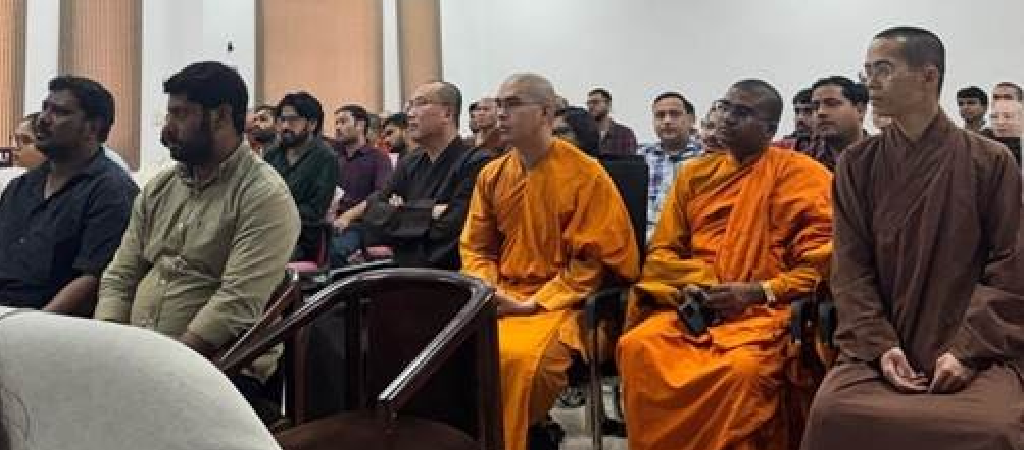
India is strengthening efforts to preserve heritage and minority languages through artificial intelligence, with a special focus on Pali, the ancient language of early Buddhist scriptures.
A workshop on Pali Language Preservation and Digital AI Model Development was held at the Faculty of Arts, University of Delhi, under the Digital India BHASHINI initiative of the Ministry of Electronics and Information Technology (MeitY). The programme was organised in collaboration with the Centre for Advanced Studies in Buddhist Studies.
The initiative aims to develop AI-powered digital language tools for Pali, considered a low-resource language in the field of artificial intelligence due to limited digital datasets and linguistic resources. Discussions focused on dataset creation, digitisation of manuscripts, audio collection, linguistic validation and community participation for building reliable AI models.
Amitabh Nag highlighted the role of artificial intelligence in improving access to knowledge systems and digital services in Indian languages. He stressed the importance of collaboration between academic institutions and language communities for developing high-quality datasets.
The workshop also showcased several BHASHINI language technology tools, including Anuvaad for text translation, Vaani Anuvaad for speech translation, Lekha Anuvaad for document translation and Chitra Anuvaad for multilingual video adaptation. The BHASHINI mobile application and BhashaDaan platform were also demonstrated to support real-time translation and community-driven language data contribution.
Officials said the initiative is part of broader efforts to build an inclusive multilingual AI ecosystem in India while preserving culturally significant and heritage languages through digital innovation.