VEDIKA is NIC’s Digital Archiving and Document Management Platform designed to help ministries, departments and public sector organizations preserve, organize and manage records throughout their lifecycle. Built on DSpace, a globally adopted open-source repository platform, and customized to meet the specific requirements of government organizations, VEDIKA transforms fragmented document collections into structured, searchable and enduring digital repositories.
Every government decision, policy, notification, report, debate and administrative record contributes to the institutional memory of the nation. Preserving these records and making them easily discoverable is essential for effective governance, transparency and accountability.
For decades, government organizations have relied on physical files and dispersed document repositories to manage information. While these systems served their purpose, growing volumes of records have made storage, retrieval and preservation increasingly challenging. Files may become difficult to trace, physical records can deteriorate over time, and information stored across multiple systems often remains difficult to access.
Digital archiving addresses these challenges by enabling records to be preserved, organized and accessed in a structured digital environment. It ensures that information remains available for future reference while significantly improving discoverability and operational efficiency.
From Document Storage to Knowledge Preservation
Digital archiving is more than simply converting paper records into electronic files. The real value lies in creating repositories where information can be systematically organized, searched and retrieved whenever required.
This is where a Document Management System (DMS) plays a critical role. A DMS provides structured storage, search capabilities, version tracking, access control, auditability and workflow support, ensuring that archived records remain useful long after they have been created.
VEDIKA combines these capabilities into a unified platform that enables organizations to preserve institutional knowledge while making information available to the right users at the right time.
The VEDIKA Platform
Developed by the National Informatics Centre (NIC), VEDIKA provides a configurable platform for digital archiving and document management across government organizations.
At its core, the platform is built on DSpace, one of the world's most widely adopted open-source repository platforms. Originally developed through a collaboration between MIT Libraries and Hewlett-Packard Laboratories, DSpace is used by thousands of institutions worldwide for long-term digital preservation and repository management.
NIC leverages this proven foundation and customizes it to meet the unique requirements of ministries, departments and public sector organizations. The result is a government-tested platform that combines international best practices with domain-specific customization.
Designed Around Organizational Needs
Every organization manages information differently. A legislative repository may require classifications for Acts, Rules and Notifications, while a parliamentary repository may organize content around sessions, debates and members.
VEDIKA accommodates these differences through configurable repository structures, metadata schemas, collection hierarchies, workflows and role-based access policies. Organizations define their document classifications, metadata requirements and access rules, while NIC configures the platform to align with these requirements. Where necessary, custom interfaces and specialized portals can also be developed to support specific operational needs.
Key Capabilities
VEDIKA provides a comprehensive set of document management and archiving capabilities, including:
- Structured organization of documents through configurable repository hierarchies.
- Advanced search using metadata and full-text indexing.
- Controlled access based on user roles and organizational requirements.
- Version tracking and auditability of document activities.
- Workflow support for submission, review and approval processes.
- Long-term preservation of digital records.
Together, these capabilities enable organizations to move beyond simple document storage and establish sustainable digital knowledge repositories.
Implementation Approach
The implementation of VEDIKA follows a structured and collaborative process.
Organizations begin by identifying records for archival and digitization. Physical documents can be scanned and processed using OCR technologies, while digital records may be ingested directly into the repository. The organization then defines document classifications, metadata structures, user roles and access policies.
Based on these inputs, NIC configures the repository, establishes workflows and collection structures, conducts testing and validation, and deploys the solution on NIC's cloud infrastructure. Following deployment, users are onboarded and supported for ongoing operations.
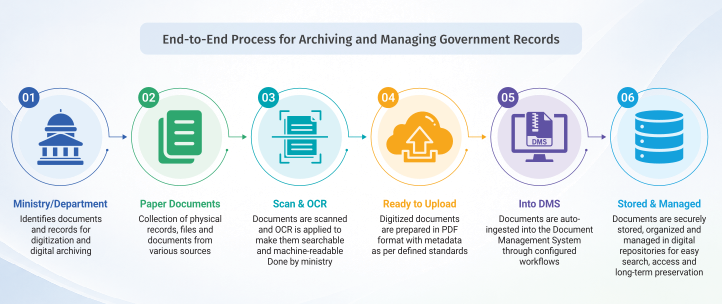
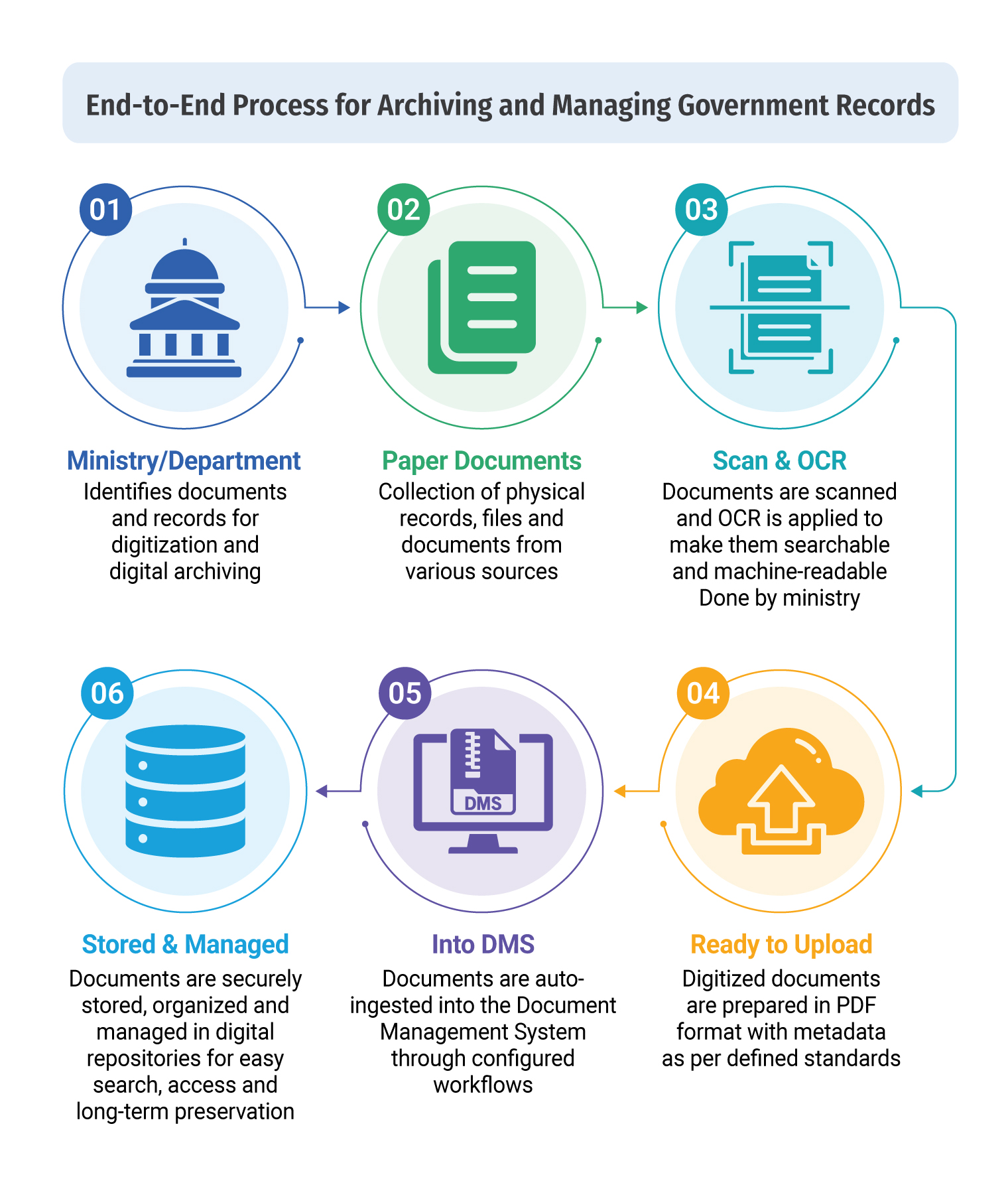 Fig: 11.1 : VEDIKA Digital Repository Implementation Framework
VEDIKA in Action
VEDIKA has already been deployed across several significant government repositories, demonstrating its versatility across both public-facing and internal archival environments.
Parliament Digital Library
The Parliament Digital Library provides a unified repository of parliamentary records, enabling users to search debates, committee reports, budget speeches and other parliamentary documents through a single platform. The repository improves accessibility while supporting transparency and public engagement.
India Code
India Code serves as a centralized legislative repository containing Acts, Rules, Regulations and Notifications from Central and State Governments. Through authenticated publication workflows, the repository ensures that users have access to verified and up-to-date legislative information.
Rajya Sabha Digital Repository
The Rajya Sabha Digital Repository preserves parliamentary debates and proceedings dating back to 1952. Its advanced search capabilities allow users to locate records across decades of parliamentary history using multiple search parameters.
Rajya Sabha Secretariat Internal Repository
The same platform also supports secure internal repositories where access is restricted according to organizational requirements. This deployment demonstrates how VEDIKA can support both public archives and confidential institutional repositories through configuration-driven access management.
Impact
By enabling systematic preservation and efficient retrieval of records, VEDIKA helps government organizations reduce dependence on physical storage, improve access to information and preserve institutional memory for future generations.
More importantly, it transforms records from static archives into accessible knowledge resources that support governance, research, transparency and informed decision-making.
Conclusion
As governments continue to embrace digital-first administration, preserving and managing information effectively has become a strategic imperative. VEDIKA provides a structured, adaptable and proven platform for digital archiving and document management, helping organizations create repositories that preserve knowledge, improve discoverability and strengthen governance.
Built on a globally trusted repository foundation and tailored to the needs of government institutions, VEDIKA is enabling the transition from document storage to long-term digital knowledge preservation.
- Edited by:AMIT AGARWAL
Author / Contributor

Ashish Vikram Asthana Dy. Director General & HOG avasthana[at]nic[dot]in

Brijesh Krishna Sharma Sr. Technical Director brijesh[at]nic[dot]in

Md. Iftekhar Khan Scientist - C md.iftekhar[at]nic[dot]in

Nivedita Aggarwal Scientist - C nivedita.aggarwal[at]nic[dot]in
- Tag:
- Internet
- Technology
- eGov
- Tech
Ashish Vikram Asthana
Deputy Director General & HoG
NIC HQ, A-Block, Lodhi Road
CGO Complex, Delhi – 110003
Share