
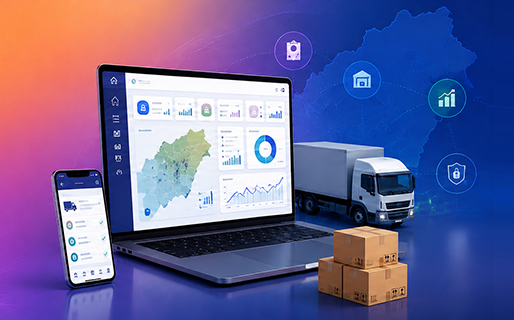
The e-Supply Chain Management System (eSCMS) is a digital platform developed for the Excise Department, Government of Manipur, to enable end-to-end monitoring of liquor distribution. Integrated with the eAbkari system, it provides bottle-level traceability through Excise Adhesive Labels (EALs), QR-code verification, and real-time inventory tracking. By digitizing supply chain operations from bottling to retail sale, eSCMS enhances transparency, prevents diversion and counterfeit products, strengthens regulatory oversight, improves revenue assurance, enables data-driven decision-making, streamlines compliance monitoring, and supports efficient enforcement across the entire supply chain.
The Excise Department, Government of Manipur, regulates the manufacture, import, storage, transportation, distribution, and sale of liquor in the State. To improve transparency, compliance, and supply chain monitoring, the department has implemented the eSCMS (e-Supply Chain Management System).
eSCMS is an integrated digital platform that tracks liquor movement from bottling to retail sale. It connects all stakeholders—including suppliers, bottlers, bonded warehouses, wholesalers, and retailers—within a centralized ecosystem integrated with the eAbkari framework.
The system uses Excise Adhesive Labels (EALs), QR codes, SSCC, GTIN, XML-based data exchange, and handheld scanning devices to enable bottle-level traceability, monitor stock movement, prevent diversion, and strengthen regulatory oversight. It also provides real-time visibility into inventory, facilitates seamless data exchange among stakeholders, improves operational efficiency, enhances compliance with excise regulations, and supports informed decision-making through accurate, timely, and centralized information.
Objectives
The key objectives are:
- Establish end-to-end digital tracking of liquor distribution.
- Ensure transparency and accountability in stock movement.
- Prevent diversion, duplication, and unauthorized sales.
- Enable bottle-level traceability through EALs.
- Streamline inventory and logistics management.
- Facilitate real-time verification through QR-code scanning.
- Integrate supply chain operations with eAbkari.
- Improve operational efficiency and inventory control.
Stakeholders Involved
The system integrates:
- Excise Department, Government of Manipur
- Distilleries / Suppliers
- Bottlers
- Bonded Warehouses
- Wholesalers
- Retailers
All stakeholders are registered through the eAbkari-Manipur system.
Role of the Excise Department
The Excise Department functions as the regulatory authority and administrator of eSCMS. Its responsibilities include:
- Stakeholder registration and management.
- Maintenance of master data for suppliers, bottlers, brands, labels, warehouses, wholesalers, retailers, and pricing.
- Creation of stakeholder user accounts.
- Management and approval of Excise Adhesive Label (EAL) requisitions.
- Monitoring stock movement across the supply chain.
System Architecture Overview
eSCMS is a centralized web-based platform integrated with handheld Android scanning devices.
The system uses standardized identification mechanisms to track liquor at both case and bottle levels. Each case is assigned a unique SSCC-based identity, while each bottle is linked to a unique EAL number.
Excise Adhesive Label (EAL) Management
The EAL serves as the primary identifier for bottle-level traceability.
- EAL Requisition: Distilleries or suppliers submit EAL requisitions to the Excise Department.
- Approval Process: Approved EALs are issued by the Excise Department to the concerned distillery.
- Distribution to Bottlers: Distilleries distribute EALs to bottlers for use during bottling operations.
Bottling and XML Upload Process
Bottlers affix EALs to bottles and upload production and packaging data through XML files. The XML file includes:
- Import Permit Number
- SSCC
- Bottle GTIN
- Case GTIN
- Pack Size
- Bottle Quantity
- Expiry Date
- EAL Numbers
After validation, the import permit becomes available for shipment processing.
Shipment and Transportation Process
Shipment details recorded in the system include:
- Import Permit Number
- Invoice Number and Date
- Transporter Details
- Vehicle Information
- Destination Warehouse
Each dispatched case carries a QR code linked to its SSCC for tracking and verification.
Receipt at Bonded Warehouse
Bonded warehouses receive consignments using handheld scanning devices.
QR Code Verification
The system:
- Scans QR codes on cases.
- Verifies shipment data against uploaded records.
- Confirms warehouse destination and shipment authenticity.
Stock Update
Upon successful verification:
- Warehouse inventory is updated automatically.
- Stock becomes available for further distribution.
Purchase Order and Dispatch to Wholesaler
In Manipur, wholesaler operations are managed by Manipur State Beverages Corporation Limited (MSBCL).
Purchase Order Submission
- Purchase orders are generated through the system.
Dispatch from Bonded Warehouse
During dispatch:
- Cases are scanned and verified.
- Movement records are generated.
- Stock levels are updated automatically.
Receipt at Wholesaler
Wholesalers verify consignments using handheld scanners.
The system validates:
- Shipment authenticity
- Purchase-order mapping
- Case details
- Destination information
Verified stock is automatically added to wholesaler inventory.
Retailer Indent and Supply Process
Retailers submit stock indents through the system.
Stock Monitoring by Wholesaler
Scenario 1: Stock Available
- Orders are processed immediately.
- Cases are scanned and dispatched.
Scenario 2: Stock Not Available
- Replenishment orders are placed with bonded warehouses.
Dispatch and Receipt at Retailer
Cases are scanned before dispatch and again upon receipt.
Receipt Verification
The system validates:
- Consignment authenticity
- Retailer mapping
- Shipment details
- Product information
After verification, retailer inventory is updated automatically.
Bottle-Level Sales and Traceability
eSCMS enables bottle-level sales verification using EAL or barcode scanning.
Before sale, each bottle is authenticated through the scanning system to confirm ownership and inventory status.
After validation, sales are processed through the POS system, which supports billing, payment collection, invoice generation, and digital payments through Razorpay-integrated channels.
Real-time sales recording automatically updates inventory.
Retail Validation
The system ensures:
- Only assigned bottles can be sold by a retailer.
- Cross-retailer sales are blocked.
- Unauthorized diversion is prevented.
Benefits of Bottle-Level Tracking
- End-to-end traceability
- Counterfeit prevention
- Diversion control
- Accurate sales monitoring
- Improved regulatory compliance
Key Features
- Centralized supply chain management
- Real-time stock tracking
- QR code-based verification
- Bottle-level traceability
- XML-based data integration
- Automated inventory updates
- Role-based access control
- Handheld device integration
- eAbkari integration
- Diversion prevention
- Audit trail and monitoring
Key Benefits
Administrative Benefits
- Improved regulatory oversight
- Greater transparency and accountability
- Stronger compliance monitoring
- Better audit management
Operational Benefits
- Faster stock handling
- Reduced manual processes
- Efficient inventory management
- Real-time stock visibility
Security Benefits
- Prevention of unauthorized movement
- Detection of diversion and counterfeit products
- Secure bottle-level authentication
Financial Benefits
- Improved revenue assurance
- Reduced revenue leakage
- Better tax and duty monitoring
Future Scope
The eSCMS is designed to support future enhancements such as damaged-stock management, stock transfers and returns, reconciliation modules, advanced analytics dashboards, mobile monitoring applications, and AI-based anomaly detection to further strengthen supply chain efficiency and regulatory oversight.
Conclusion
The eSCMS provides a comprehensive digital framework for monitoring liquor distribution in Manipur. By integrating all stakeholders into a single platform and enabling bottle-level traceability through EALs, QR-code verification, and real-time inventory management, the system strengthens regulatory control, improves operational efficiency, prevents diversion, and enhances revenue assurance.
Its integration with eAbkari further supports effective governance and streamlined excise administration across the State.
This version is roughly 35–40% shorter, removes most of the repetitive explanatory text, and reads more like an Informatics/technical governance article rather than a project report.
- Edited by: LAL BAHADUR SINGH
Author / Contributor

N. Binod Singh Sr. Technical Director & SIO binod[at]nic[dot]in

S. Ramesh Singh Scientist - C ramesh.s[at]nic[dot]in
- Tag:
- Internet
- Technology
- eGov
- Tech
State Informatics Officer
NIC Manipur State Centre
NKN Block, New Secretariat
Imphal, Manipur - 795001
Share