
Delhi’s digital transformation reflects a shift toward integrated, citizen-centric governance. Platforms across service delivery, administration, finance, healthcare, and welfare have enhanced transparency, efficiency, and accessibility. Systems like e-District, IFMS, eOffice, and DDIS demonstrate strong inter-departmental coordination, while data-driven tools and digital infrastructure ensure scalability and responsiveness. Overall, Delhi has evolved from isolated digitization to a cohesive, technology-enabled governance ecosystem.
Delhi, as the administrative, political, and strategic nucleus of the nation, represents a unique convergence of historical legacy and contemporary urban transformation. The National Capital Territory has, in recent years, emerged as a frontrunner in leveraging ICT to strengthen governance frameworks.
Under the aegis of the Government of NCT of Delhi, NIC Delhi has spearheaded a series of digital initiatives aimed at enhancing service delivery, improving transparency, and streamlining administrative processes. The focus has been on developing integrated, scalable, and citizen-centric platforms that enable seamless access to public services and foster efficient inter-departmental coordination.
Given the scale and diversity of the city, these interventions have been complemented by data-driven decision-making and smart governance solutions across key sectors, including healthcare, education, transport, and public administration.
This article presents an overview of the major ICT initiatives and digital interventions undertaken in Delhi, highlighting their role in advancing a transparent, efficient, and citizen-centric governance ecosystem aligned with the vision of Digital India.
ICT Initiatives in the State
Citizen Platforms
Delhi’s digital transformation places citizens at the centre by simplifying access, reducing delays, and improving transparency. Unified platforms deliver certificates, registrations, grievances, and welfare services through a single interface, making governance more responsive and accessible.
e-District
e-District Delhi is a flagship platform that enables end-to-end digital delivery of public services, significantly reducing the need for physical visits and streamlining administrative processes. It offers features such as single sign-on access, Aadhaar-based authentication, digitally signed certificates, integrated online payments, and DigiLocker support. The platform also ensures inter-departmental verification, real-time application tracking, automated workflows, and timely service delivery through eSLA. With over 453 services across 41 departments, more than 87 lakh registered users, and more than 128 lakh applications processed, e-District has emerged as a cornerstone of digital governance in Delhi.
CM Jan Sunwai Portal
The CM Jan Sunwai Portal serves as a unified grievance redressal mechanism, enabling citizens to register complaints, track progress, and provide feedback directly to the government. Accessible via web, mobile applications, and the CM Helpline (1902), the platform ensures transparency through real-time tracking, automated routing to departments, escalation of unresolved cases, and time-bound resolution. Relaunched on 21 February 2026, it further strengthens participatory governance and responsiveness.
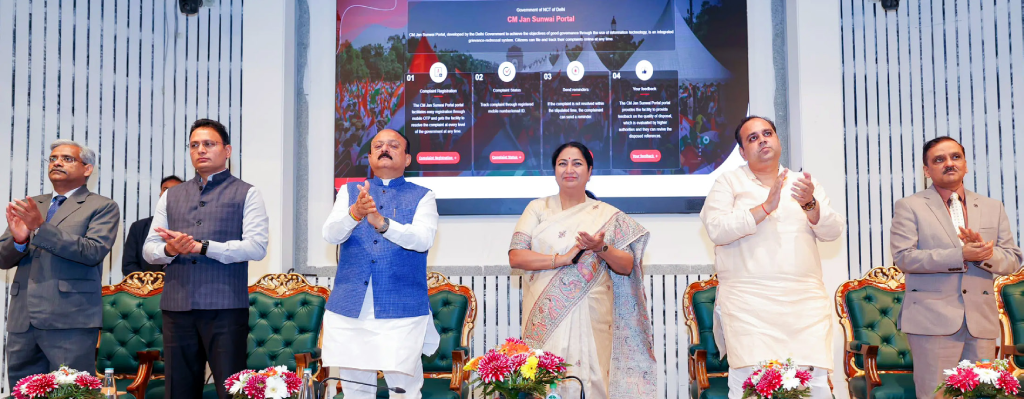 Fig: 2.4 : Hon’ble Chief Minister of Delhi, Smt. Rekha Gupta,
launching the ‘CM Jansunwai Portal’ along with Hon’ble Minister of IT, Dr. Pankaj
Kumar Singh, Hon’ble
Minister of Education, Shri Ashish Sood, and other officials
Fig: 2.4 : Hon’ble Chief Minister of Delhi, Smt. Rekha Gupta,
launching the ‘CM Jansunwai Portal’ along with Hon’ble Minister of IT, Dr. Pankaj
Kumar Singh, Hon’ble
Minister of Education, Shri Ashish Sood, and other officials
Delhi’s e-Governance journey reflects its commitment to responsive and transparent administration. Platforms developed by NIC Delhi like CM Jan Sunwai have strengthened grievance redressal by enabling direct communication between citizens and the government, ensuring timely resolution. Similarly, the e-District portal has simplified access to essential services such as certificates and licenses through a single digital interface. These applications have reduced paperwork, improved efficiency, and ensured time-bound delivery.
The Delhi Development Information System (DDIS) is another NIC Delhi initiative for streamlined monitoring and improved governance of development initiatives across the National Capital Territory enabling end-to-end tracking from proposal to execution and ensuring transparency and efficient fund utilization.
I compliment the Team of NIC, Delhi for their initiatives and sincere efforts in facilitating the Govt. of NCT of Delhi to expand its digital ecosystem, building a responsive and transparent governance model that truly empowers its citizens.

Smt. Rekha Gupta
Hon’ble Chief Minister, DelhiRTI Online System
The RTI Online System simplifies access to information by enabling citizens to file applications digitally across more than 200 public authorities. By reducing manual processes and expanding accessibility, it reinforces transparency and accountability in governance.
LG Listening Post
The LG Listening Post functions as a centralized grievance monitoring system for the Lieutenant Governor Secretariat, supported by a mobile application. It enables real-time tracking of complaints and improves responsiveness through better oversight and coordination.
DBT Delhi Portal
The DBT System ensures efficient delivery of welfare benefits by directly transferring funds to beneficiaries, minimizing intermediaries and leakages. Integrated with the DBT Bharat Portal, it enhances targeting, transparency, and overall efficiency in public welfare distribution.
eSLA
The eSLA system operationalizes the Delhi Right of Citizen to Time-Bound Delivery of Services Act, 2011, by monitoring service timelines across departments. Covering 48 departments and 565 services, it strengthens accountability and ensures that citizens receive services within defined timeframes.
Delhi’s progress in digital governance reflects a clear vision of building a responsive, transparent, and citizen-first administration. Initiatives such as e-District platform, eSLA, e-Abgari, eHospital, EWS Admissions have transformed the way public services are delivered, making them more accessible, efficient, and accountable. These applications have empowered citizens by reducing procedural delays and ensuring time-bound service delivery. Delhi’s progress in digital governance reflects a clear vision of building a responsive, transparent, and citizen-first administration. Initiatives such as e-District platform, eSLA, e-Abgari, eHospital, EWS Admissions have transformed the way public services are delivered, making them more accessible, efficient, and accountable. These applications have empowered citizens by reducing procedural delays and ensuring time-bound service delivery.
The contribution of NIC has been critical in creating a robust, secure, scalable, and integrated digital ecosystem. Their technical expertise has enabled seamless implementation of various e-Governance initiatives across departments.
Going forward, the Government of Delhi remains committed to deepening digital integration, enhancing user experience, and adopting emerging technologies such as artificial intelligence and data analytics. Our priority is to ensure that every citizen benefits from these advancements, making governance more inclusive, efficient, and future-ready.

Shri Rajeev Verma, IAS
Chief Secretary, Government of NCT-DelhiGovernance & Administration
NIC Delhi has digitized internal government processes to enable efficient administration, better coordination, and data-driven decision-making through streamlined workflows, enhanced transparency, and real-time visibility.
eOffice
The eOffice platform has been instrumental in moving government functioning toward a paperless and efficient system. It enables electronic creation, movement, and tracking of files, along with digital document management and record-keeping. By reducing reliance on physical paperwork, eOffice improves transparency, speeds up decision-making, and fosters seamless coordination across departments, PSUs, and institutions.
SPARROW
SPARROW digitizes the Annual Performance Appraisal Report (APAR) process for government officers, ensuring a transparent, standardized, and timely evaluation system. By maintaining secure, centralized service records and enabling online submission and processing, it enhances consistency and accountability in performance management.
DDIS
The Delhi Development Information System (DDIS) serves as a comprehensive platform for monitoring development works across schemes, enabling end-to-end tracking from proposal to execution. It supports project proposal entry, multi-level approvals, fund release tracking, and progress updates with photographic evidence. With over 8,000 projects onboarded, DDIS has significantly improved transparency, fund utilization, and oversight of development initiatives through real-time monitoring dashboards for senior officials.
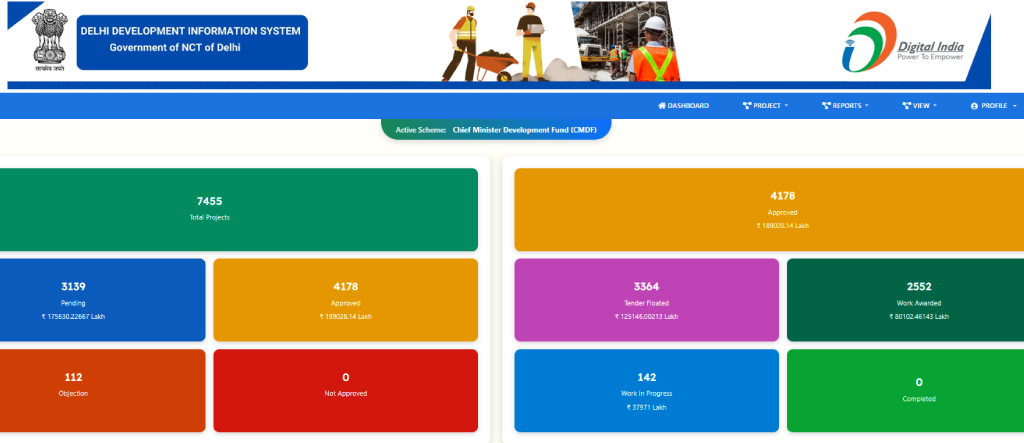 Fig: 2.1 : DDIS Portal Homepage
DARPAN 2.0
DARPAN 2.0 is a 24×7 real-time monitoring and analytics platform that tracks government schemes and projects while offering insights through trend analysis, peer comparison, and demographic profiling. By enabling data-driven decision-making, it strengthens policy formulation and performance monitoring. Following a successful pilot, it is now approved for rollout across all departments.
eSamiksha
The eSamiksha platform supports continuous monitoring and review of key government programmes, enabling real-time tracking, periodic assessments, and timely interventions. With dedicated dashboards for senior officers, it enhances accountability and ensures that projects are completed within defined timelines.
CM Schedule Management System
The CM Schedule Management System streamlines the planning and management of the Chief Minister’s engagements through a digital platform and mobile application. It enables centralized scheduling of meetings and appointments, real-time updates, and improved coordination, ensuring better time utilization and administrative efficiency.
Financial Management & Public Expenditure Systems
NIC Delhi has strengthened fiscal governance by implementing digital financial systems that ensure transparency, efficiency, and accountability in public expenditure. These platforms enable end-to-end digitization of budgeting, bill processing, payments, and reconciliation, significantly reducing manual intervention and minimizing leakages.
IFMS
The Integrated Financial Management System (IFMS) serves as the backbone of Delhi Government’s financial operations, streamlining salary disbursement and enabling real-time monitoring of budgets, expenditure, and fund flows. Adopted across more than 1,700 Drawing and Disbursing Officers (DDOs) and 25 Pay and Accounts Offices (PAOs), IFMS integrates multiple components, including the Centralised Billing System for bill generation, the GPF Monitoring System for managing provident fund accounts, De-Lekha for expenditure consolidation, the Government e-Payment Gateway for secure transactions, and the Delhi SGST Reconciliation System for tax reconciliation. The IFMS Delhi Mobile App further enhances accessibility by allowing employees to conveniently view salary slips and GPF details.
SNA-SPARSH
The SNA-SPARSH system is an integrated platform for managing fund flows under Centrally Sponsored Schemes. Through its integration with PFMS, RBI e-Kuber, and NPCI, it enables a “just-in-time” fund release mechanism and supports both DBT and non-DBT payments. This improves cash management and ensures real-time tracking of fund disbursement across central and state levels.
ePayment
The ePayment system enables digital collection of government receipts through integration with banking platforms such as the State Bank of India’s e-Pay portal. By facilitating online payment of government dues across departments, it enhances transparency, improves efficiency, and offers greater convenience to citizens and businesses.
eProcurement
The eProcurement system digitizes the entire procurement lifecycle, from tender publication to bid submission, evaluation, and contract management. By ensuring transparency, reducing manual processes, and enabling end-to-end tracking, it strengthens fairness and efficiency in public procurement.
eBhavishya
The eBhavishya system streamlines pension sanction and disbursement through a fully digital workflow. It enables end-to-end tracking of pension cases, online submission of forms, and real-time status updates through SMS and email notifications. By reducing delays and manual intervention, the system ensures timely, transparent, and efficient delivery of pension benefits across the Government of NCT of Delhi.
Delhi SGST Reconciliation System
The Delhi SGST Reconciliation System facilitates accurate reconciliation of State GST data by integrating with national financial systems such as GSTN and RBI e-Kuber. By automating reconciliation processes, it enhances accuracy in revenue accounting and strengthens fiscal transparency and compliance.
Justice & Legal Ecosystem
NIC Delhi has strengthened the justice delivery framework by introducing digital platforms that enhance coordination, transparency, and efficiency across legal and judicial systems. Through seamless information sharing, digitized workflows, and real-time case monitoring, these initiatives are transforming how justice is administered and accessed.
ICJS
The Interoperable Criminal Justice System (ICJS) enables real-time integration among key pillars of the criminal justice system, including police, courts, prisons, prosecution, and forensic departments. By facilitating seamless exchange of case-related information, it improves coordination among stakeholders, accelerates investigations and case processing, and enhances transparency in justice delivery.
eLitigation
The eLitigation system provides a centralized digital platform for managing government-related court cases. It supports electronic filing, tracking, and monitoring of cases, reducing manual processes while improving efficiency and over-sight in handling litigation involving government departments.
MedLeaPR
The MedLeaPR system streamlines medico-legal and post-mortem reporting through digital documentation, standardized templates, secure storage, and integration with CCTNS, ensuring timely access for legal processes. The eLitigation platform enables centralized filing, tracking, and monitoring of government cases, reducing manual processes.
RCMS
The Revenue Court Case Monitoring System (RCMS) digitizes revenue court proceedings across multiple levels, including SDM, ADM, DM, and Financial Commissioner courts. It enables citizens to file petitions online, upload documents, track case progress and hearings, and manage appeals, thereby making revenue justice processes more accessible and transparent.
OSWS
Online Single Window System (OSWS) for counsels provides a fully digital mechanism for submission and processing of fee claims, ensuring timely and transparent payments while integrating seamlessly with departmental workflows.
Labour Court Case Monitoring System
The Labour Court Case Monitoring System enables end-to-end digital management of labour-related cases. It supports online case filing, hearing management, case transfers and reopening, and public access to case details, along with automated notices and cause lists. By digitizing labour dispute resolution, it enhances efficiency, transparency, and accessibility in labour justice systems.
Across the judiciary, several Court Systems have been implemented to streamline operations in the Delhi High Court and District Courts. These include the Case Information System (CIS) for case management, the National Judicial Data Grid (NJDG) for transparency, and services such as e-Filing, e-Court Fee, and e-Inspection. Additional features like e-Cause Lists, automated allocation of bail applications, and video conferencing for virtual hearings have significantly improved accessibility, efficiency, and responsiveness in court functioning.
Healthcare Systems
NIC Delhi has significantly advanced the digitization of healthcare services, focusing on improved patient care, efficient resource management, and real-time decision-making. These platforms enable better coordination across hospitals and health departments while enhancing transparency and responsiveness in service delivery.
NextGen eHospital
The NextGen eHospital system is an integrated Hospital Management Information System (HMIS) designed to streamline healthcare services and hospital administration. It enables efficient patient management and provides real-time data for informed decision-making. Currently being implemented across 38 government hospitals in Delhi, it forms the backbone of the city’s digital healthcare ecosystem.
PCPNDT Online Form-F Portal
The PCPNDT Online Form-F Portal ensures compliance with the PCPNDT Act by enabling digital reporting and monitoring of diagnostic centres, including private ultrasound facilities. With over 95 lakh Form-F submissions and more than 2,400 centres registered, the platform has strengthened transparency, compliance, and regulatory oversight.
Health Data Management Portal
The Health Data Management Portal serves as a centralized platform for real-time monitoring of health data across Delhi. It supports hospital logistics, bed availability (including ICU beds), disease surveillance, drug supply management, and oxygen tracking, enabling data-driven governance and efficient healthcare administration.
Hospital Bed Information Mobile App
A Hospital Bed Information Mobile App, integrated with the NextGen eHospital system, is being developed to provide citizens with real-time information on ICU bed availability, ensuring timely access to critical care services.
Drug Monitoring System
The Drugs Monitoring System is a web-based platform that tracks regulated drugs, ensuring controlled distribution and preventing misuse. By enabling stock tracking, sales recording, and reporting for chemists and administrators, it enhances transparency in the pharmaceutical supply chain.
Nursing Home Management System
The Nursing Home Management System digitizes the registration and renewal of nursing homes through a fully online, paperless process. It captures detailed information on facilities, staff, and services, supports inspections and compliance workflows, and enables digital issuance of certificates. With integrated payment, notifications, and reporting features, it improves efficiency, transparency, and regulatory oversight.
Food Samples Testing Management System
The Food Samples Testing Management System facilitates digital tracking of food sample collection, testing, and reporting across Delhi. By ensuring time-bound processing and enabling real-time monitoring by authorities, it strengthens food safety enforcement, compliance, and accountability.
Social Welfare Systems
NIC Delhi has leveraged digital technologies to strengthen welfare delivery by improving transparency, inclusivity, and efficiency. These platforms streamline beneficiary management, enhance compliance, and expand access to welfare and labour services across the city.
ePDS
The ePDS (Electronic Public Distribution System) is an end-to-end digital platform for managing food grain distribution under the National Food Security Act. Integrated with SMART-PDS and supported by ePOS devices, it enables real-time monitoring, last-mile authentication, and portability under One Nation One Ration Card. Serving over 72 lakh beneficiaries and 17 lakh ration cards, it has significantly improved transparency and efficiency in food distribution.
Delhi Labour Welfare Board Portal
The Delhi Labour Welfare Board Portal digitizes the administration of welfare schemes and the Labour Welfare Fund. It enables employer registration, online contribution payments, employee data management, and access to updates, thereby enhancing accessibility and transparency in labour welfare services.
Shop & Establishment Exemption System
The Shop & Establishment Exemption System simplifies regulatory compliance by enabling online submission and processing of exemption requests under the Delhi Shops and Establishments Act. By offering a transparent and time-bound approval process, it reduces manual intervention and improves ease of doing business.
Outsource Wages Payment Management System
The Outsource Wages Payment Management System ensures timely and transparent wage disbursement to outsourced personnel through centralized tracking and integration with departmental workflows. By reducing delays and discrepancies, it strengthens accountability and promotes fair compensation in contract-based employment.
Education and Recruitment Systems
Delhi has adopted digital platforms to streamline admissions and recruitment, ensuring transparency, efficiency, and wider access while enabling fair, merit-based selection with minimal manual intervention.
eCounseling
The eCounseling system serves as a centralized platform for online admissions across major institutions under the Government of NCT of Delhi, including GGSIPU, NSUT, DTU, IGDTUW, IIIT, SCERT, and ITIs. It enables online registration, choice filling, and automated seat allocation, ensuring a transparent, efficient, and student-friendly admission process with reduced physical interface.
EWS Education Portal
The EWS Education Portal facilitates online applications for admissions under EWS, DG, CWSN, and Freeship categories. By simplifying the application process and ensuring transparent seat allocation, it promotes inclusivity and expands access to education for economically weaker and disadvantaged sections.
DSSSB OARS
The DSSSB OARS platform supports end-to-end digital management of recruitment processes for the Delhi Subordinate Services Selection Board. It enables online registration, application submission, fee payment, and applicant communication, ensuring efficient handling of large-scale recruitments while enhancing transparency and reducing manual intervention.
Business, Regulation and Ease of Doing Business
NIC Delhi has strengthened the business ecosystem by digitizing regulatory processes, simplifying licensing, approvals, inspections, and compliance. These platforms reduce delays, minimize physical interface, and enhance transparency, creating a more efficient and business-friendly environment.
eAbkari
The eAbkari system is a comprehensive digital platform for managing excise operations, enabling end-to-end processing of licenses, permits, and liquor movement. It supports license issuance and renewal, permit generation, inventory tracking, label registration, and duty management, while also strengthening enforcement through inspection monitoring and barcode-based tracking. Integrated dashboards provide real-time insights for decision-making. The Delhi eAbkari mobile app further enhances accessibility by allowing users to locate vends, verify product authenticity, check dry days, and register grievances.
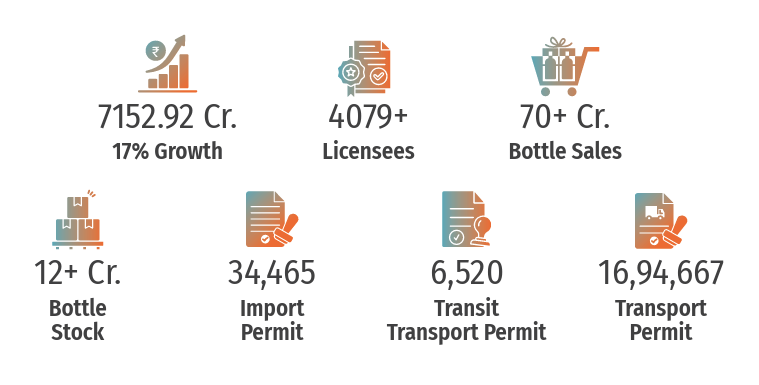 Fig: 2.2 : A Statistical Overview of the eAbkari System
Delhi Single Window System for Industry
The Delhi Single Window System for Industry provides businesses with a unified interface to obtain approvals and clearances from multiple departments. By enabling online applications, real-time tracking, integrated workflows, and time-bound service delivery, it reduces paperwork, improves coordination, and significantly enhances ease of doing business.
D-CIS
The Delhi Central Inspection System (D-CIS) streamlines inspection processes across departments by eliminating duplication and ensuring standardized procedures. It improves coordination among authorities, reduces compliance burden on businesses, and creates a transparent and predictable inspection framework.
eFilm Clearance System
The eFilm Clearance System offers a single-window platform for obtaining filming permissions across Delhi. By integrating multiple departments into a unified workflow, it enables online applications, faster approvals, and reduced paperwork, promoting Delhi as a film-friendly destination while ensuring efficient regulatory compliance.
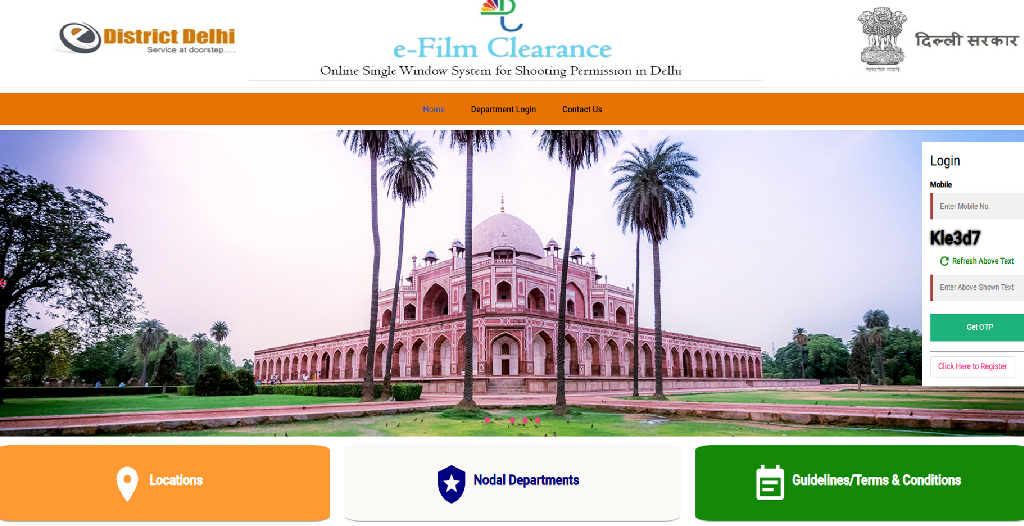 Fig: 2.3 : eFilm Clearance Portal
Other Major Initiatives
Beyond core governance systems, NIC Delhi has expanded digital transformation across legislative processes, property registration, land management, and consumer protection, enhancing transparency, efficiency, and citizen convenience.
Delhi NeVA Project
The Delhi NeVA (National e-Vidhan Application) Project, launched on 3rd August 2025 at the Delhi Legislative Assembly, enables a fully digital and paperless legislative workflow under the Digital India Programme. It supports real-time management of questions, notices, bills, and proceedings, along with automated workflows and digital archiving. Implemented within an accelerated 100-day timeline, the platform enhances transparency, accessibility, and data-driven decision-making for legislators and officials. With dedicated NeVA Sewa Kendras and operational support, Delhi has become the 20th Legislative Assembly to adopt this system, advancing the vision of “One Nation, One Application.”
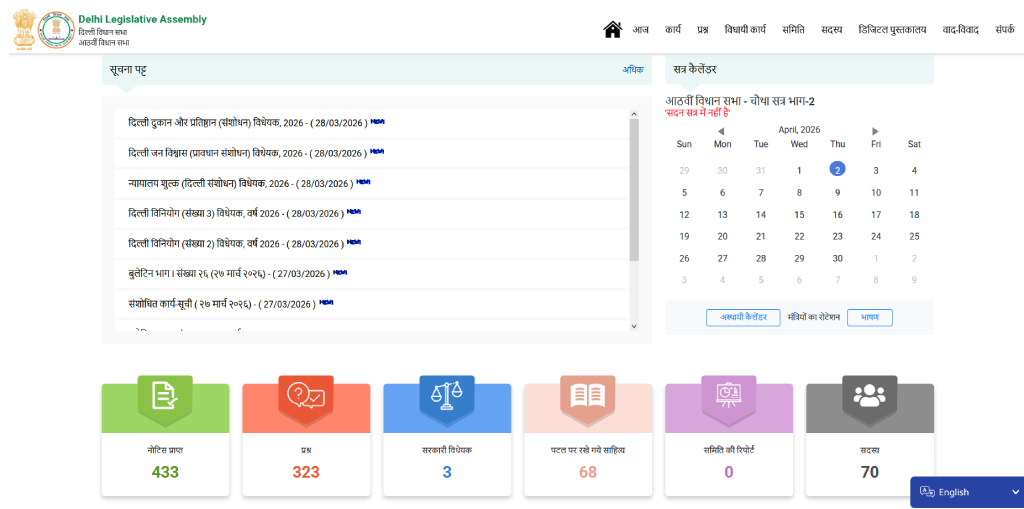 Fig: 2.5 : NeVA Delhi Assembly Portal
It gives me immense pleasure that the National Informatics Centre, through its magazine Informatics, proposes to highlight the implementation of the National e-Vidhan Application (NeVA) in the Delhi Legislative Assembly. The authority of a legislative institution rests not only in the continuity of its constitutional traditions but equally in its ability to adapt, with care and judgement, to the changing requirements of governance. It is in this spirit that the Delhi Legislative Assembly undertook the full implementation of NeVA during the Monsoon Session of the First Part of the Eighth Legislative Assembly Session, marking a considered step toward modernizing its working processes.
The transition to NeVA has enabled the Assembly to move toward a more cohesive and efficient system of operation, where legislative business is supported by timely and structured digital access. Notices, questions, papers to be laid on the Table, and proceedings of the House are now available through a unified digital platform, allowing Members to approach legislative work with greater readiness and continuity. The shift has brought a quiet yet definite improvement in the manner in which business is prepared, conducted and recorded, while also ensuring that institutional records are maintained in a form that is both reliable and readily accessible.
The National Informatics Centre has played a steady and enabling role in this process. Its technical support, combined with an understanding of the procedural character of legislative work, has ensured that the adoption of NeVA has been smooth and responsive to the Assembly’s practical requirements. The effort reflects a careful alignment of technology with established practices, without disturbing the discipline and order that are essential to the functioning of the House.
At a broader level, the move carries significance beyond administrative convenience. A digital legislative framework strengthens transparency, improves access to information, and supports more informed participation within the House. It also serves to reinforce public confidence by ensuring that governance processes remain open, clear and accountable.
The collaboration between the Delhi Legislative Assembly and the National Informatics Centre stands as a thoughtful example of how institutions can evolve without losing their grounding. I place on record my appreciation for NIC’s continued commitment and look forward to further strengthening this association in the service of efficient, transparent and responsive legislative governance.
I extend my sincere best wishes for the continued success of Informatics and for its efforts in documenting and disseminating such important initiatives.

Shri Vijender Gupta
Member of Delhi Legislative AssemblyNGDRS
The NGDRS (National Generic Document Registration System) digitizes the property registration process by enabling online document registration, appointment booking, e-stamping integration, automated fee calculation, and real-time status tracking. By reducing physical visits and standardizing procedures, it improves transparency and ease of property transactions.
Vehicle Location Tracking and Emergency Alert System (VLT & EAS)
VLT & EAS enhances vehicle safety through real-time GPS tracking and monitoring. It enables authorities to track movement and ensure compliance. The emergency alert feature allows instant distress signals to control centers, ensuring quick response, improved passenger safety, and efficient incident management.
Land Records System
The Land Record System digitizes land ownership, records, and transactions, ensuring transparency and easy access. It reduces disputes, improves accuracy, enables online verification, and streamlines land administration processes for citizens and authorities.
MaapTol Portal
The MaapTol Portal supports the Weights & Measures Department by enabling online verification and certification of measuring instruments, along with grievance registration and tracking. Supported by mobile applications and real-time field inspection capabilities, it enhances consumer protection, regulatory efficiency, and transparency in enforcement.
Network and Infrastructure Services
A robust digital infrastructure underpins Delhi’s e-Governance ecosystem, enabling secure connectivity, seamless communication, and reliable service delivery across departments. It supports both citizen-facing services and internal operations, ensuring scalability, efficiency, and continuity of governance.
The Delhi State Wide Area Network (DSWAN) forms the backbone of this ecosystem, providing high-speed, secure connectivity across more than 185 government locations through over 240 dedicated leased lines. It supports a wide range of services, including LAN management, internet and email services, cloud access, VPN connectivity, web hosting, and Wi-Fi, enabling real-time communication and seamless inter-departmental coordination.
NGC Cloud Services offer a secure and scalable environment for hosting applications and data, allowing departments to deploy services quickly while optimizing infrastructure through centralized resource management. The Biometric Attendance System (BAS) enhances transparency and accountability by enabling real-time monitoring of employee attendance, improving administrative efficiency.
Video Conferencing (VC) Services enable virtual meetings across state and district levels, supporting faster decision-making, reducing the need for travel, and ensuring continuity in governance.
Together, these initiatives create a resilient digital backbone that powers efficient, secure, and scalable e-Governance in Delhi.
Important Events organized
- Inauguration of CM Jan Sunwai portal, e-District Services through CSC Digital Seva Kendra, EWS Admission portal by Hon’ble Chief Minister, Delhi along with Minister of IT and Minister of Education.
- Inauguration of MedLeaPR by Hon’ble CM of Delhi
- Inauguration of the Delhi NeVA Project by Speaker of Delhi Legislative Assembly
Way Forward
Going forward, the focus should be on deeper integration, interoperability, and data-driven governance. Leveraging AI and analytics can enable proactive service delivery. Strengthening cybersecurity, capacity building, and mobile-first inclusive access will be key. Enhanced citizen participation and unified platforms can further improve transparency and efficiency, driving Delhi toward a more intelligent and resilient governance ecosystem.
- Edited by:VINOD KUMAR GARG
Author / Contributor

Nittal Srinivas Dy. Director General & SIO nsrini[at]nic[dot]gov[dot]in
- Tag:
- Internet
- Technology
- eGov
- Tech
State Informatics Officer
NIC Delhi State Centre
B-Wing, Level-7, Delhi Secretariat, New Delhi, Delhi 110002
Share