The National Informatics Centre (NIC), through its International Cooperation Division (ICD) under the Ministry of Electronics and Information Technology (MeitY), continues to play a key role in advancing India’s digital diplomacy. By sharing India’s Digital Public Infrastructure (DPI) with partner nations, NIC supports inclusive, efficient, and technology-driven governance—particularly across countries of the Global South.
India’s DPI model, built on scalable, open, and citizen-centric platforms, has attracted global interest for its ability to deliver public services at population scale. Through ICD, NIC facilitates international cooperation by offering technology solutions, technical expertise, and capacity-building support to countries seeking to strengthen their digital governance ecosystems.
The International Cooperation Division of NIC serves as the nodal unit for engaging with foreign governments, international organizations, and multilateral institutions on digital governance. Its mandate includes sharing India’s proven e-Governance platforms, supporting customization for local contexts, providing technical assistance, and enabling knowledge exchange through training and collaborative projects.
Cuba : ICD Engagement
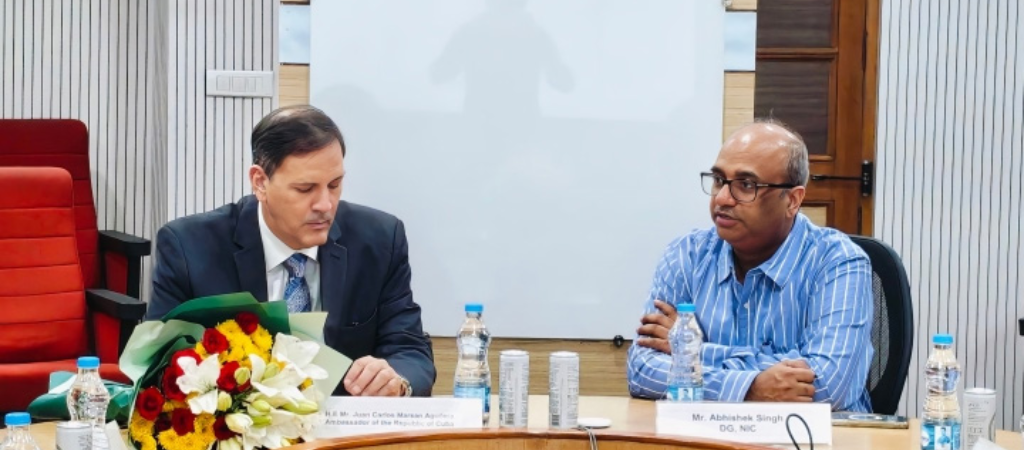
A high-level Cuban delegation led by H.E. Juan Carlos Marsan visited NIC Headquarters on 18 November 2025. The delegation held discussions with Shri Abhishek Singh, Additional Secretary, MeitY and Director General, NIC, along with senior officials of the International Cooperation Division.
The discussions focused on digital governance, healthcare digitalization, and technology-enabled public services. NIC showcased several of India’s DPI platforms, including eHospital, eOffice, and AI-enabled governance solutions.
The Cuban delegation expressed strong interest in adopting these platforms, particularly for improving healthcare access and administrative efficiency. Both sides discussed possibilities of pilot implementations, technical consultations, and capacity-building support for Cuban officials and IT teams.
 Kenya’s delegation, led by H.E. Mercy Wanjau, visited NIC for strategic
discussions with Dr. RK Pathak, DDG and HOG (ICD),NIC to explore deeper
collaboration in ICT-enabled public service delivery
Kenya’s delegation, led by H.E. Mercy Wanjau, visited NIC for strategic
discussions with Dr. RK Pathak, DDG and HOG (ICD),NIC to explore deeper
collaboration in ICT-enabled public service delivery
Kenya : ICD Engagement
A Kenyan delegation led by H.E. Mercy Wanjau visited NIC on 21 November 2025 and held strategic discussions with Dr. R.K. Pathak, DDG and HoG (ICD), NIC. The focus was on strengthening ICT-enabled public service delivery and integrated governance. NIC demonstrated key platforms including ICJS, eOffice, and eHospital.
The Kenyan delegation showed keen interest in integrated governance platforms, especially ICJS, for improving coordination, transparency, and service efficiency. Discussions also covered possible technical collaboration, system customization, and phased implementation strategies.
Capacity Building and Customization
NIC’s international cooperation focuses on capacity building through training, workshops, localized platforms, and continuous technical support—ensuring technology transfer builds lasting digital capability, not just software.
Way Forward
The engagements with Cuba and Kenya led to a shared understanding on exploring pilot projects for selected DPI platforms, setting up technical consultations for system adaptation, developing training and knowledgeexchange programmes, and strengthening institutional cooperation through structured follow-up mechanisms. These discussions lay a strong foundation for deeper and sustained collaboration in digital governance.