


Page 35 - Informatics
P. 35
Technology Update


         Zero Trust Architecture


         Framework to Strengthen Structural Security of Modern Enterprise


         Edited by MOHAN DAS VISWAM            raditional  security  in  based  on  the  concept  of   ed on a per session basis
                                               trusted  and  untrusted  zones.  These  zones  are   •  Access  to  resources  is  determined  by  dynamic
                                            Tdefined  by  physical  or  logical  perimeter  pro-  policy - including the observable state of client
         Zero Trust Architecture or ZTA     tected by security devices like firewall. Any device/   identity, application, and the requesting asset -
                                            user inside the perimeter is treated as trusted and   and may include other behavioural attributes
         is an infrastructure design        is allowed access to internal resources by default. An   •  The enterprise ensures that all owned and associ-
                                            example of such a design is a typical office network   ated devices are in the most secure state possible
         philosophy based on the            local area network (LAN). Any device/ user inside the   and monitors assets to ensure that they remain in
         principle of ‘never trust, always   office LAN is allowed access to the internal office re-  the most secure state possible
                                            sources like eOffice, eFiles, eHRMS, network printers,   •  All resource authentication and authorisation are
         verify’. It debunks the typical    or any other computer/ server within the LAN. This   dynamic and strictly enforced before access is al-
                                            design assumes that all devices/users within the of-  lowed
         ‘castle-and-moat’ style perimeter   fice LAN are genuine and authorised. It also assumes   •  The  enterprise  collects  as  much  information  as
                                            that all programs running within these devices are   possible about the current state of network in-
         security and intends to handle     safe  and  non-malicious.  However,  with  high  speed   frastructure and communications and uses it to
                                            internet access on these devices, we have seen time   improve its security posture
         newer threats of privilege         and again that these trusted devices/ programs can
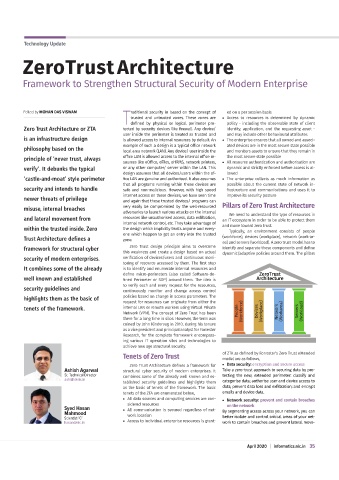
         misuse, internal breaches          very  easily  be  compromised  by  the  well-resourced  Pillars of Zero Trust Architecture
                                            adversaries to launch various attacks on the internal   We need to understand the type of resources in
         and lateral movement from          resources like unauthorised access, data exfiltration,   an IT ecosystem in order to be able to protect them
                                            internal network control, etc. They take advantage of   and move toward zero trust.
         within the trusted inside. Zero    the design which implicitly trusts anyone and every-  Typically,  an  environment  consists  of  people
                                            one which happen to get an entry into the trusted
         Trust Architecture de!nes a        zone.                              (workforce), devices (workplace), network (work-ar-
                                                                               ea) and servers (workload). A zero trust model has to
                                               Zero  Trust  design  principle  aims  to  overcome
         framework for structural cyber     this weakness and create a design based on actual   identify and separate these components and define
                                                                               dynamic/adaptive policies around them. The pillars
         security of modern enterprises.    verification of devices/users and continuous moni-
                                            toring of resource accessed by them. The first step
         It combines some of the already    is to identify and enumerate internal resources and
                                            define  micro-perimeters  (also  called  Software-de-  ZeroTrust
         well known and established         fined  Perimeter  or  SDP)  around  them.  The  idea  is   Architecture
                                            to verify each and every request for the resources,
         security guidelines and            continuously  monitor  and  change  access  control
         highlights them as the basic of    policies based on change in access parameters. The
                                            request for resources can originate from either the
         tenets of the framework.           internal LAN or remote workers using Virtual Private
                                            Network (VPN). The concept of Zero Trust has been   People   (Workforce)  Devices  (Workplace)  Network  (Workarea)  Servers  (Workload)
                                            there for a long time in silos. However, the term was
                                            coined by John Kindervag in 2010, during his tenure
                                            as a vice president and principal analyst for Forrester
                                            Research, for the complete framework encompass-
                                            ing  various  IT  operation  silos  and  technologies  to
                                            achieve new age structural security.
                                                                               of ZTA as defined by Forrester’s Zero Trust eXtended
                                            Tenets of Zero Trust               model are as follows,
                                               Zero Trust Architecture defines a framework for   •  Data security: encryption and secure access
                        Ashish Agarwal      structural  cyber  security  of  modern  enterprises.  It   Take a zero-trust approach to securing data by pro-
                        Sr. Technical Director  combines some of the already well known and es-  tecting  the  new,  extended  perimeter:  classify  and
                        ashish@nic.in       tablished  security  guidelines  and  highlights  them   categorise data; authorise user and device access to
                                            as the basic of tenets of the framework. The basic   data; prevent data loss and exfiltration; and encrypt
                                            tenets of the ZTA are enumerated below,  emails and device data.
                                            •  All data sources and computing services are con-  •  Network security: prevent and contain breaches
                                              sidered resources
                        Syed Hasan          •  All communication is secured regardless of net-  on the network
                        Mahmood               work location                    By segmenting access across your network, you can
                        Scientist-’C’       •  Access to individual enterprise resources is grant-  better isolate and control critical areas of your net-
                        hasan@nic.in                                           work to contain breaches and prevent lateral move-


                                                                                        April 2020  informatics.nic.in 35

