


Page 39 - info_oct_24
P. 39
Technology Update


              measure that  divides  a network into isolated   Mitigation:   Implement   strong   password   Poor Credential Hygiene
              segments to prevent attackers from moving   policies that require complex, unique passwords,   Many organizations suffer from poor credential
              freely  across  the  network.  Without  proper   and  enforce  multi-factor  authentication  (MFA)   hygiene, including the use of weak passwords,
              segmentation, attackers who gain access to one   across  all  accounts.  Regularly  audit  and  update   password reuse, and storing passwords in
              part  of  the  network  can  easily  move  to  other   access controls to ensure they remain effective   plaintext.  These  practices  make  it  easier  for
              systems, increasing the risk of data breaches and   against  evolving  threats.  Centralized  identity   attackers to gain access to systems, especially if
              insider threats.                    management  solutions  can  help  enforce  MFA is not enabled.
                Mitigation:  Segment  the  network  based  on   consistent access control policies across all
                                                                                       Mitigation:  Enforce strong password policies,
              roles and functions, ensuring that sensitive areas   systems and applications.  requiring complex and unique passwords for each
              (such as databases or production environments)   Weak or Misconfigured Multi-Factor   account.  Implement  a  password  management
              are separated from user and public-facing areas.   Authentication (MFA)  solution to help users securely store and manage
              Utilize  firewalls,  VLANs,  and  access  control  lists               their credentials. Regularly rotate passwords, and
              (ACLs)  to  enforce  strict  communication  rules   While  MFA  provides  an  additional  layer   never store them in plaintext.
              between network segments. Implement zero-trust   of   security,   misconfigurations   or   weak
              principles where every network access request is   implementations  can  still  leave  systems  Unrestricted Code Execution
              verified, regardless of origin.     vulnerable to attacks. Allowing insecure fallback   Unrestricted  code  execution  occurs  when
                                                  options,  such  as  SMS-based  authentication,
              Poor Patch Management               or  not  enforcing  MFA  across  all  user  accounts,   attackers can run arbitrary code on a target
                                                                                     system. This can happen through vulnerabilities
                Patch  management  is  crucial  for  addressing   reduces its effectiveness.  such as buffer overflows, SQL injection, or cross-
              known  vulnerabilities  in  software  and  systems.   Mitigation:  Ensure  that  MFA  methods  are   site scripting (XSS). Attackers often exploit system
              However,  many  organizations  fail  to  apply   robust and resistant to common attacks such as   drivers or use scripting languages to execute
              patches in a timely manner, leaving their systems   phishing or SIM swapping. Organizations should   malicious activities without triggering security
              vulnerable  to  attacks.  Unpatched  systems  are   consider  using  more  secure  options  like  app-  alerts.
              often  easy  targets  for  attackers  using  publicly   based  authenticators  or  hardware  tokens.  MFA   Mitigation:  Regularly  update  and  patch  all
              available exploits.                 should be enforced for all users, particularly for   software to prevent exploitation of known
                Mitigation:  Implement  an  automated  patch   privileged accounts and remote access.  vulnerabilities.  Use  web  application  firewalls
              management process that regularly checks for   Insufficient Access Control Lists   (WAFs)  and  input  validation  to  protect  against
              updates and applies patches as soon as they   (ACLs) on Network Shares and   SQL  injection  and  XSS  attacks.  Restrict  the  use
              are  available.  Prioritize  patches  based  on  the                   of  executable  files  and  scripting  languages
              severity  of  vulnerabilities  and  maintain  an   Services            to trusted sources, and regularly monitor for
              accurate inventory of all software and systems to   ACLs define who can access certain resources   suspicious activities related to code execution.
              ensure that nothing is overlooked. Organizations   on  a  network.  If  not  properly  configured,
              should also avoid using unsupported software   unauthorized users may gain access to sensitive   Conclusion
              or hardware, as they no longer receive security   data, modify files, or even take control of systems.   Misconfigurations   are   among   the
              updates.                            Poor ACL configurations on network shares are a   leading  causes  of cybersecurity breaches
                                                  common target for attackers.       Addressing  them    proactively  can
              Bypass of System Access Controls     Mitigation: Carefully configure ACLs to restrict   significantly  reduce  the  risk  of  compromise.
                Attackers can bypass access controls through   access  to  sensitive  resources.  Ensure  that  only   By  following  best  practices  such  as  enforcing
              methods such as brute force attacks, phishing, or   authorized users can access network shares and   access  control,  implementing  MFA,  establishing
              using stolen credentials. This allows them to gain   services,  and  regularly  audit  ACL  settings  for   effective patch management, and configuring ACLs
              unauthorized access to systems and sensitive data.   vulnerabilities.  Use  role-based  access  control   properly, organizations can bolster their defenses
              Weak access control mechanisms, especially in   (RBAC)  models  to  simplify  the  management  of   against  cyberattacks.  Continuous  monitoring,
              third-party applications, often exacerbate this risk.  permissions.    regular  audits,  and  proactive  configuration
                                                                                     management are essential steps in maintaining
                                                                                     robust security configurations.
                                                                                       Ultimately,   mitigating   cybersecurity
                                                                                     misconfigurations   requires   vigilance   and
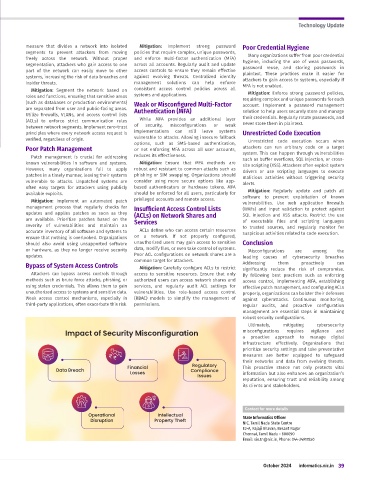
                           Impact of Security Misconfiguration                       a proactive approach to manage digital
                                                                                     infrastructure  effectively.  Organizations  that
                                                                                     prioritize security settings and take preventative
                                                                                     measures are better equipped to safeguard
                                                                                     their  networks  and  data  from  evolving  threats.
                                                                     Regulatory
                                               Financial                             This proactive stance not only protects vital
                        Data Breach                                 Compliance
                                                Losses                               information but also enhances an organization’s
                                                                       Issues
                                                                                     reputation, ensuring trust and reliability among
                                                                                     its clients and stakeholders.
                                                                                      Contact for more details
                                   Operational           Intellectual                 State Informatics Officer
                                   Disruption           Property Theft                NIC, Tamil Nadu State Centre
                                                                                      E2-A, Rajaji Bhavan, Besant Nagar
                                                                                      Chennai, Tamil Nadu - 600090
                                                                                      Email: sio.tn@nic.in, Phone: 044-24917850


                                                                                            October 2024  informatics.nic.in 39

